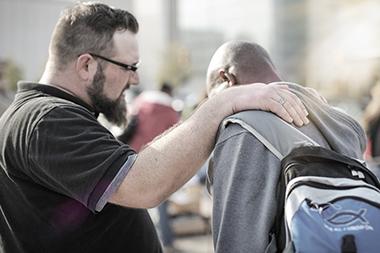
A psychologist, counselor, and teacher shares his thoughts on how to speak to people in difficult circumstances. The most important thing for us to recognize is that what people need most is understanding. While understanding always provides the foundation for other kinds of help, it is important in and of itself. Understanding is a wonderful gift to give others. Having all the answers is overrated. Ask 20 people to tell you who has had the most influence on their lives, and in the vast majority of cases you will find the notable absence of the phrases "gives good advice" or "always provides great solutions to problems," and the frequent presence of phrases such as "is a good listener" or "really understands." We all want to be understood. We want to be around people who show genuine humility, who empty themselves of their own concerns, and who give us their full attention. We are drawn to people who suspend their own needs to control and dominate and who display openness to our story. We seek relationships with people who really want to tune into the meaning of another's experience and are willing to express that meaning back to us. And of course, such a posture invites us to look inside ourselves and recognize that we need to be that kind of person.
Two Steps to Understanding
2. Expand your understanding of the problem. This takes us beyond the skills of listening to a broader view of the problem itself. Doctors are a good example of a combination of these two skills. They need to be good listeners and ask the right questions. But they also need to understand medical problems. Good process needs to be combined with good content. Adapted from How Do I Help a Hurting Friend. (Baker, 2006.) Used with permission. Copyright © 2006 Rod J.K.Wilson. Reflect1. Describe a time when you received understanding and wise counsel from another person. 2. What are some characteristics of a good listener? 3. Why is it so important for church leaders to combine good listening and wise counsel when they face difficult questions? Think through how you'll deal with relational problems in your small-groups ministry. Even children can benefit from small groups. How to use Scripture in pastoral counseling. Ministry Cutting Edge What do our senior adults need most from the church?
| ||||||||||||||||||||