Buiding Church Leaders Home
Search By:
Advanced Search
Church RoleTopicFree Samples
Train LeadersAssess My ChurchConnect With LeadersRespond to CrisisMentor & DiscipleMultimediaStore
Home > Articles > Making Sense of Worship
Making Sense of Worship
Q & A with Sally Morgenthaler.


Topics:Changes in worship, Contemporary worship, Experiencing God, Worship, Worship planning, Worship service, Worship style
Filters:Pastor, Worship, Worship leader, Youth ministry, Youth pastor
References:Psalm 150, John 4:24, Revelation 5
Date Added:July 12, 2007

Sign up for our free Building Church Leaders newsletter:


Average Rating: Not yet rated


Submit Your Rating and Review:

Choose star rating:

Name:
Comments: 1000 character limit 


Appealing To the Visual
In "Appealing To the Visual," you'll find interviews and articles to help you learn how to incorporate visual tools into your church.

Planning the Worship Service
Plan, implement, and execute a worship service that will benefit the congregation.


Community, not Commodity
Let us acknowledge, and even mourn, what we lose when worship meets media.

Leader of the Band
How to develop a worship team.

 1 of 4

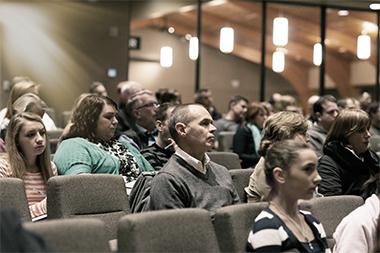
Sally Morgenthaler, whose book Worship Evangelism surfaced above the waves of resources for churches adjusting to changing worship styles, is still trying to help churches stay relevant in worship style to the changing culture of their members. Speaking at forty-plus seminars a year, she is guiding churches to incorporate more of the senses to envelop worshipers in a total experience that gets their minds out of the pews or off what they must do on Monday. She spoke recently to worship leaders at the Hollifield Leadership Center in Conover, North Carolina.

Q. How is worship changing? How must worship change?

A. Our experience of God always is a form. If we didn't live on this planet we would worship God without some kind of package, but experience is always mediated. The reality is we get God in a form. God recognized this by sending Jesus in a form, in a particular culture, gender, and time in history, God in flesh and blood. We experience the infinite in a form and those forms change. They change with language, they change with our experience, and they change as the world changes. The way we worship needs to be changed.

Let's say we have the same worship responses as we did in 1920 or 1880 when we were a rural culture. We are singing hymns about plowing and harvesting. Our experience has changed. To have immediacy in worship—if we are going to be able to access God— those songs have to go through a transformation. Plowing may not be the metaphor that works for us now. Maybe it is going to be something about the city, maybe a metaphor about rush-hour traffic.

Q. People assume they have a relationship with God. How has that mentality developed?

A. We used to think we got God sort of as a product of church attendance. To be in relationship with God or to sense or experience God we had to go to church. Over the past twenty to twenty-five years, people have investigated a plethora of other portals into the spiritual. It could be nature worship, Buddhism, New Age. More people are visiting Belief.net than are going to church on Sunday morning. So we have a whole lot more suppliers of "spiritual product." And we have gotten out of the sense that we go to meet God in a building. We go to yoga class, we buy crystals.

Spirituality has been commercialized. Look at the spiritual book section of Barnes & Noble. It is completely different now than twenty years ago when you had a Judeo-Christian book section and a few Muslim offerings. Now there are endless permutations. People don't have to come to church to access God any more. The perception is that God is who you make God to be. We are living off fragments of big systems, putting it together for ourselves.

As we saw after 9/11, with all the little shrines that people built, people want to make God tangible. Culture has moved so much into the visual, art, painting, sculpture, story—anything that preserves mystery. People don't want information in their religious experience by itself. They want information only in context with what they can feel. They don't want to get info on God in a lecture.


Login

E-mail:

Password: