Buiding Church Leaders Home
Search By:
Advanced Search
Church RoleTopicFree Samples
Train LeadersAssess My ChurchConnect With LeadersRespond to CrisisMentor & DiscipleMultimediaStore
Home > Articles > Helping People Care for One Another
Helping People Care for One Another
The first step in helping people move into ministry is to remind them that they are part of a royal priesthood.


Topics:Congregational care, Development, Discipleship, Healing, Leadership, Pastoral care, Shepherding, Spiritual care, Spiritual direction, Spiritual formation
Filters:Church staff, Counseling, Discipleship, Elder, Pastor, Pastoral care, Shepherd, Spiritual director
Purpose:Discipleship
References:Exodus 19:6, 1 Peter 2:5-9
Date Added:July 12, 2007

Sign up for our free Building Church Leaders newsletter:


Average Rating: 


Posted: May 06, 2009
elyse  (Guest)
taks 4 all the help ya'll


Submit Your Rating and Review:

Choose star rating:

Name:
Comments: 1000 character limit 


Believing God
Learning to walk in your faith.

Leading Financial Stewardship


Where Are the Leaders?
Equipping the next generation for leadership.

The Gift of Rebuke
How I learned to take correction - and give it.

 1 of 5

Over a decade ago, I visited an exciting church in the inner city of Chicago. While most Sunday sermons in that neighborhood echoed through half-empty auditoriums, the sermons of this church's pastor reached overflow crowds Sunday after Sunday. Obviously, it was an unusual church. People weren't just dropping their money in the plate and then putting their feet up while the pastor did all the work. They believed they were called to minister and by God's power could minister.

I had a chance to talk at length with the pastor. "What's the secret of your success here?"

"Simple," he said. "I just tell people who they are: chosen by God, his children, his priests. I don't shame them for what they are not; I tell them who they are."

At that moment, I promised myself, If ever I return to the pastorate, I'm going to remember that. I did return, and I kept that promise. I've been telling people who they are, and it works. Let me use my experience with University Presbyterian Church's (UPC) lay ministry as a prime example.

A Kingdom of Priests

Just before God gave Moses the Law, he instructed Moses to tell the people they were to be a kingdom of priests (Exod. 19:6). The New Testament repeats that theme. Peter refers to the believers as a holy and royal priesthood (1 Pet. 2:5,9). At the very end of the Bible, the same theme is repeated, that Christians are called to be a kingdom of priests (Rev. 1:6).

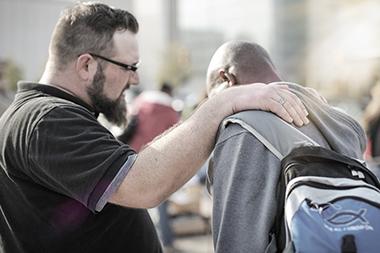
Primarily, a priest is a person who mediates between God and another person. A priest is a channel of forgiveness, grace, mercy, healing. A priest provides pastoral care. This is what God has called every believer to do and to be. The first step, then, in helping people move into ministry is to remind them of that, to tell them, "You are priests."

For the most part, Jesus didn't pick as his disciples the highly trained, the well educated. Not that he chose unqualified people; I think those twelve were the most qualified. They didn't have to unlearn other disciplines. They had clean slates. At least three were fishermen, and one was a government employee, but none were clergy (rabbis).

These are the men told by Jesus, "I will make you fishers of men." He didn't say, "Maybe you will be" or "I'll try to teach you how." He said they would become that, and they did.

But what does that mean today—to be fishers of men, to be priests? When we tell people they are priests, what are we calling them to do?

I believe this priesthood involves four facets of ministry, four separate roles in which every Christian needs to function. We all are to be evangelists, ministers of healing, missionaries, and prophets.

Called to Be Evangelists

When I arrived at UPC, the evangelism department had just two responsibilities: to provide a special evangelistic speaker for one week each year and to follow up on visitors.